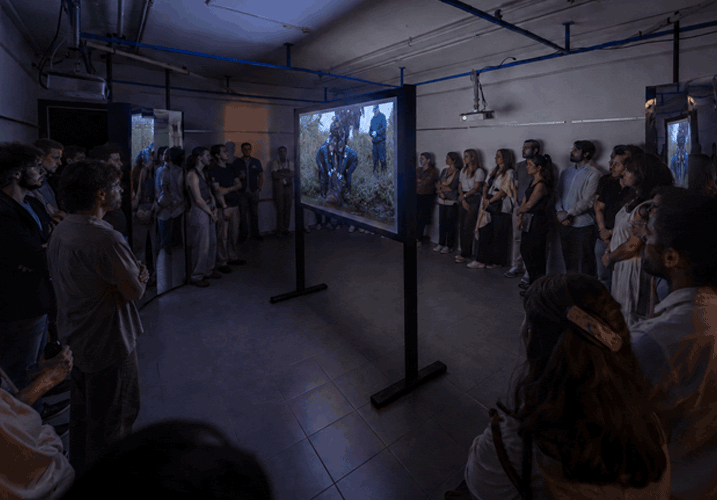
Point of View is a conceptual and research-based video installation that explores the way we see, interpret, and construct meaning from partial information. The project is based on three true stories, each reconstructed and presented through two different perspectives of the same situation.
At the center of the project is the gap between what we see and what we think we see. A shift in angle, distance, context, or the order in which information is revealed can completely change the meaning of an event. Through these three stories, the project examines our tendency to fill in missing information, draw conclusions quickly, and construct a narrative before the full picture is revealed.
The project was developed as my B.Des graduation project in Visual Communication and received an Excellence Award.
Concept and Research
The project is grounded in research into visual perception, semiotics, and the way images acquire meaning. Throughout the process, I explored theories and writings on the relationship between gaze, signs, interpretation, and context, including ideas by John Berger and Ferdinand de Saussure, as well as the concept of polysemy and the ability of a single image to carry multiple meanings at once.
This research led to the central question of the project:
Do we truly see what is in front of us, or do we see the interpretation we create for it?
Rather than presenting the viewer with a single answer, the installation is designed to encourage a process of re-reading. Information that initially appears clear and unambiguous can take on an entirely different meaning once another perspective is revealed. In some cases, the exact same visual detail can shift from being a sign of one thing to a sign of something completely different.
Visual
Reconstruction


Each of the three films is based on a real event and was developed through an extensive process of research and visual reconstruction.
Testimonies, archival materials, photographs, spatial references, and documented details were collected in order to reconstruct the environments, characters, and events as accurately as possible.
The scenes were then rebuilt through a combination of photography, direction, design, and AI-based editing and production tools. AI was used as part of the visual production process rather than as a replacement for creative decision-making. Every frame was shaped through deliberate choices of composition, camera angle, lighting, movement, character design, props, and continuity.
A significant part of the process focused on creating a believable and consistent sense of reality. This included reconstructing real spaces, maintaining character and visual continuity across entire sequences, and transforming still imagery into moving scenes with natural, cinematic motion.
The process involved extensive experimentation, refinement, and repeated reconstruction until the technology itself became almost invisible and the visual experience remained at the center.
Two Screens, One Moment

The final outcome was designed as a synchronized video installation projected across two screens simultaneously.
Both screens present the same event, but each reveals different information and guides the viewer toward a different interpretation of the situation.
Each pair of films shares the same synchronized soundtrack, allowing sound to function as a common anchor while the visuals continuously shift its meaning. A sound that may feel threatening when paired with one image can take on a completely different meaning when experienced through the second perspective.
The installation also included distorted mirrors positioned along the sides of the screens, offering fragmented glimpses of what was happening on the opposite screen.

Because the reflections were intentionally warped, the viewer never received a complete or fully reliable image.
The mirrors were designed to reflect the way the human mind behaves when information is missing. When we cannot see the full picture, we instinctively fill in the gaps, interpret partial information, and sometimes distort reality in the process.
The two-screen format is therefore not simply a method of display, but an essential part of the concept. The viewer cannot fully focus on both perspectives at the same time and is constantly forced to choose where to look, what to follow, and inevitably, what to miss.

Project Goal
The goal of Point of View is not to determine which perspective is correct, but to challenge the confidence with which we assign meaning to what we see.
By presenting the same reality from two different directions, the project explores how perception is shaped by context, prior knowledge, personal experience, distance, and the way information is presented.
It invites the viewer to return to the moment in which they were certain they had already understood the story, and to reconsider that certainty.
The reality does not change between the two screens.
What changes is the information we are given, and what we do with it.